Showing posts with label books. Show all posts

Tuesday, August 26, 2014

Our 2014-15 School Year Plans

We have begun the school year!  I have both a first and fourth grader this year.  My philosophy on education is that we use plenty of good, real books - not textbooks! - and learn about real things around us, making sure to get the kids outside each day that is possible... and having relatively short lessons makes time for that.  Here is what we are doing this year and a bit about how it is going so far...

Morning Basket
(note: it does not all fit in the basket!  Shh, don't tell anyone!)

This used to be our "Circle Time," and it has evolved to remain as a whole-family together time while not merely being about the calendar and singing seasonal songs (although we still do that for the youngers!).  Now it also includes more meat... read-alouds from different books daily, picture and composer study, and poetry and Shakespeare memorization.

Here's our Morning Basket daily schedule:


Circle Time/Morning Basket 2014-15

First and Fourth Grades

 Daily:

* Recite Monthly Prayer

* Sing Hymn (at least 3x/week)


* Calendar/Vestments on priest – Cecilia; Caroline does finger plays with Lucy
* Caroline: Problem of the Day (math word problem)

* CCL: Time/amount of day, word families, counting patterns, odd/even numbers at easel

* Read about saint of the day; oral narration (alternate between the girls): Saints for Young Readers for Every Day Volumes One and Two

* Poetry reading/recitation; Shakespeare quotes


Our calendar with saint magnets to mark feast days


Mondays:

* A Nest for Celeste, oral narration (alternate)

* Burgess Bird Book for Children, separate written narrations (I write Cecilia’s)

++after Nest for Celeste is finished, we will read from various other bird books like Bird Watchers and Feeders, etc.++
* Peterson Field Guide Birds coloring book


Tuesdays:

* Among the People (start with Pond, then move on to Forest); oral narration (alternate)

* Composer Study (bios, listen to specific pieces, draw the song: Handel, Beethoven, Wagner)

* Life of Fred - one lesson, each girl in own book; written 'Your Turn to Play' in notebooks


Wednesdays:

* Catholic Mosaic/liturgical year story; oral narration (alternate)

* Picture Study; oral narration, sketch from memory on easel (alternate girls wkly.) - Giotto, Michelangelo, Raphael

* Nature Walk in yard: find one thing for Nature Calendar of Firsts, collect specimens/photos for later work in Nature Notebooks


Last week, we studied our first Giotto painting... after looking closely and making observations, the girls close their eyes and visualize the painting, then try to recall everything they can.  Caroline made a rough outline sketch from memory on the easel and then I put the painting up next to it.


Thursdays:

* Among the People (start with Pond, then move on to Forest); oral narration (alternate)

* Plutarch’s Lives of the Greeks; written narration from Caroline

* Once Upon a Time Saints for Cecilia only; oral narration (transcribed by me)


Fridays:

* Handbook of Nature Study (girls choose one relevant topic to read about each week)


The girls in the mirror above their watercolor crayon project from Artistic Pursuits
Each day the girls also have independent "morning work," which consists of things they can do on their own.  Cecilia's includes hands-on manipulative type materials such as puzzles, which she can do along with Lucy.  On Fridays, they listen to prayers in Latin on a CD so they can begin to learn some of them.  The guy reading the prayers sounds like he is about to fall asleep whenever he says, "Amen," but hey, it was a free CD.


Caroline's Stuff


Caroline's major topics in 4th grade are Ancient Greece and British History.  She is also beginning some study of Shakespeare this year for the first time, which she LOVES (ask her to quote from Midsummer Night's Dream if you want proof! ;).  She is continuing with Math U See (Delta) as well as doing Life of Fred for math.  She whizzed through the younger LoF books late last year and is picking up with the Honey book to start off this year.  These books are so hilarious, in a really odd way.  It's learning math concepts through a story.  A story for nerdy people.  Perfect.  For instance, an excerpt from the third book in which place value is being taught: "Fred turned to the nurse who had just finished stacking up 324 boxes.  He asked her what she thought about stacking up 5,367,948 boxes in the hallway outside his classroom.  She laughed and left the room."  Earlier in the book, Fred gets a cat scratch on his nose and consults his alphabetized bookshelf to find out what he should do, and he finds these titles: "Castanets for Everyday Use, Casual Pizza Restaurants, Cat Scratches: What to Do, and Cattleman: What it Takes to Be One."  My kids love these books so far.

Here are the books Caroline will be using throughout this year:
* Famous Men of Greece
* The Children's Homer
* Archimedes and the Door of Science
* Science in Ancient Greece
* D'Aulaire's Book of Greek Myths
* Tales from Shakespeare
* How to Teach Your Children Shakespeare
* Children's Encyclopedia of British History
* Our Island Story
* Augustine Came to Kent
* Beorn the Proud
* If All the Swords in England
* Castle Diary
* Our Island Saints
* 57 Stories of Saints
* St. Jude, Friend in Hard Times
* Simply Grammar
* Intermediate Language Lessons
* Faith and Life 4
* St. Joseph's Baltimore Catechism No. 1
* Paddle to the Sea
* Seabird
* Maps, Charts, and Graphs D


She is also using a neat science kit on light, and she is continuing with her recorder using the nine-note recorder book.

There are some other chapter books she will read this year set in South America, and she will begin studying the countries there on maps.  She will also continue exploring the United States - learning capitals, locations of states, general information about the states, and doing a project/report on one specific state of her choosing.  I have tons of fun puzzles, kids' atlases, games, etc. for learning about the states, and once a week she will select something to work with from the crate full of this stuff.

Doing a states puzzle with Lucy


Cecilia's Stuff

Cecilia will be using these books this year:
* New Catholic Picture Bible
* Little Angel Readers A and B
* The Earth (water section)... and this is hilarious, but this book costs $260 now used on Amazon.  I, of course, paid much, much, much less than this a few years ago!
* Math U See Alpha
* Draw Write Now (water animals)
* First Timeline and corresponding booklist
* Aesop's Fables
* This is Our Family
* St. Joseph's First Communion Catechism
* other books all mentioned in morning basket plans

Cecilia works with "Decimal Street" for a Math U See lesson

She is also excited to be starting a journal this year where she can write and draw about whatever topics she chooses.  She is making a book about Rivers, Lakes, and Oceans in which she will draw or put photos of visits to a local stream/pond area plus things such as drawings of the water cycle as she understands it, water-related experiments, etc.  Another fun thing she is doing is Family Geography - learning about her parents, grandparents, and great-grandparents and where they lived.  This maps maps relevant to her life as she begins to grasp the idea of what the United States looks like and where we are in the world.  She is making a book for this with her family tree, old photos of family members at their homes or in their hometowns, recipes from family members or regions they were from, saints who lived in those areas, etc.  Google Earth has made this so cool... we were able to find the house where my mom first lived as a baby, just for maybe a year, and compare the street view to an old photo of my mom outside the house with her mother... it had the same awnings over the windows!!!  My dad recently showed me the lot where his father's childhood home was in Superior, WI and the bar his uncle owned around the corner, the church near their house where they went, etc.

She will also be hearing several picture books... each week she will hear at least one from Catholic Mosaic related to a saint whose feast day is celebrated that month, as well as the First Timeline books - lots of good ones there.

Some of our liturgical year and first timeline books, plus a story about Handel, our composer for the first term.  Yay for interlibrary loans!


So, we have completed a little over a week, officially.  I have to keep days marked off for attendance-reporting purposes, but other than that, we are pretty free to school as we wish here in Georgia.  That means a day in the field of nature study plus a book on CD on the car ride home are a school day.  I know all the books listed above look like a lot... but the great thing is that every lesson takes anywhere from 5-30 minutes.  We might read just a short chapter at a time and stretch a book over an entire year.  For Cecilia, her first grade lessons are no more than about 20ish minutes for each different book or topic.  Now, she will spend another half hour illustrating her Old Testament story, but that is fine - her own interest is leading that.  By having short but focused lessons, it leaves them with plenty of free time - all afternoon, pretty much, after a bit of book work right after lunch when Lucy is napping/resting (meaning I can work with the older two relatively undisturbed!)... and they can explore their own interests further, draw, write, play outside, read whatever other books they want, create things using art materials and such...

illustrating Adam and Eve in the Garden of Eden

Lucy tries out the watercolor crayons while the older girls do an Artistic pursuits lesson

Fridays are "fun days," I say... they have fewer lessons in books and get to do an art project that day, plus we try to have "tea time" when we can, where they have a fun snack and tea, and they listen to me read a book aloud.  last year, we read the entire Catholic Treasure Box Book series.  This year we have started with The Seven Little Sisters Who Live on the Round Ball that Floats in the Air

Tea Time last Friday, celebrating the Feast of the Queenship of Mary with a "crown cake," aka apple butter cake made in a cathedral cake pan that was Almost a Big Mistake (see explanation of random caps further below in this post).


So here is a bit of what we have done so far...

This is one of Caroline's language lessons.  Her sense of humor shines through in her work so far... wonder if this would be frowned upon were she in school?  Note what she has written in #3.  We had just read and listened to Winnie the Pooh by A. A. Milne on CD:

Caroline picks up on the humor and other interesting quirks about author's writing styles now that she is older and rereading books that she had read aloud to her in previous years.

This one is her retelling of the story of Saints Joachim and Anne, Mary's parents.  She adopted Milne's writing style in her own writing, as well as her own quirkiness in her description of Joachim's age and what the temple leaders may have thought about him:

"Not Having Any Children at the age of Probably Past Thirty," "Ponder About This," and "What Had Happened to Joachim"

Greek history narration of The Children's Homer... and here she includes pronunciation keys to say the Greek names, as well as writing a forward which you should "keep in mind" as you read the rest of the book...  She also adds footnotes to her own writing and references previous things she has written or defines terms that may be unfamiliar.  Like I said, quirky.  How did she get this way??  I'm going to guess genetics/personality plus tons of reading of good literature.  She is very self-motivated when it comes to reading and breezes through books every time we get some at the library.
Caroline has a notebook in which to keep all her written narrations.

This is one thing I am most excited about:
We got a set of maps that go with the books Paddle to the Sea and Seabird and some lesson ideas for using them.  These books by Holling C. Holling are fabulous... they teach science concepts and geography in a way that is not at all boring, but instead through engaging stories.  We are reading Paddle to the Sea first.  In it, a boy living by a small lake in Canada just north of Lake Superior carves a wooden canoe which he sets in the melting snow.  He knows that the Great Lakes flow into each other, "like great bowls set into a hillside," and wants his canoe to flow all the way down into his lake, through all the Great lakes, and eventually into the ocean.  So by reading this book, we follow the canoe and learn all the states, cities, lakes, rivers, and other geography along the way.  Just by reading the book and coloring/labeling the map, we will learn the Great Lakes region.  Another of Holling's books will take us down the Mississippi River.  So cool!  After reading the first few pages, this is what Caroline did on the map.  In the top left corner, you can see the small lake, Lake Nipigon.  Then she found Canada's border and labeled it and colored it.  For some reason she got carried away and randomly labeled and colored Maine, even though the canoe has gone nowhere near that far yet, ha ha.

Caroline decided that all our Mary statues needed crowns for the Queenship of Mary.  Our Lady of La Leche already has one, so the others got paper crowns.

We are working through our second full week of school now and have upcoming travel, hands-on family geography study, field trips, and the start of dance class, religious education classes at our parish, and our first Catholic homeschool Friday Mass and get-together.  This school year is officially underway, and I have been enjoying the calm (somewhat - I do have a red-headed two year old, after all ;) settling into of a rhythm for the year.

Tuesday, July 30, 2013

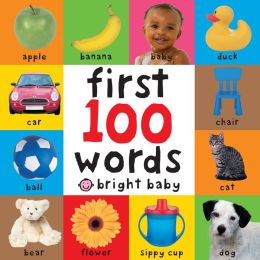
"Baby's First Words" Books


You have probably seen those big board books for babies and toddlers... the ones that say "Baby's First 100 Words" or "Baby's First 1,000 Words" or "My First 1,000 Words in French," and so forth.  We have some such book, and it has the words under bright photos of things that are supposedly early words spoken by children.  They typically are full of things like farm animals and pets, basic household furniture, some fruits and vegetables, basic vehicles like cars, trains, and airplanes, articles of clothing, and sometimes basic actions like skip, smile, jump...

BORING!
(y'all should detect my sarcasm in this post... I am not calling babies who enjoy these books, including my own, boring, nor am I suggesting the things pictured in these books are unimportant words to know... just a disclaimer, you know...)

I'd like to suggest that someone invent the "Eclectic Baby's First 1,000 Words" book.  You know, for those babies whose vocabularies develop in atypical ways.  For instance...

Instead of "pizza," how about...


t-bone?

Instead of "car," how about...

Volvo?

Instead of "dance," how about...

arabesque?


Others to consider...

bucket truck?
(instead of the standard old "dump truck" and "airplane" - maybe there could even be distinctions between "tree service bucket truck with 60 foot boom" and "utility service bucket truck," for the baby who must adhere to precise details)


tabernacle?  genuflect?  priest?
(these would appear in the "Catholic Baby's First 1,000 Words" version)


weed wacker?  lawnmower?  chainsaw?
(much more advanced than a simple "hammer")


Chick-fil-A?
(rather than generic "restaurant," although it could be seen as marketing to children within the book)

iPad?
(important to include if daddy has one for work so toddlers will learn to stop calling it "Daddy's pad")

La Leche League meeting?
(this could go in the "Breastfed Baby's First 1,000 Words" version in place of the "bottle" picture)


Pope(s)?
(Lucy can id Benedict by name easily; still working on Francis)


hummus and pita?  beets?  figs?  shrimp?
(for the baby with a mature palate)

Lucy's word book would be interesting, huh?  Of course, other young toddlers have given me other ideas of additions to the Eclectic Baby's First Words book...

Caroline contributed the words "lemur" and "apparently" as a young two year old.  But I don't know how to show a picture of "apparently," so that one won't make the final edit unless somebody can figure it out for me.

My brother Tim contributed "barracuda" as a one year old.  This is a really fun word for a toddler to say, trust me.  Or try it out by asking a one or two year old to say it.

I do think I would also add an image of a duck upside-down in the water, looking for food, with the label "duck bottom."  Why?  Because Lucy recently pointed to a drawing in a book of a duck's rear end sticking out of the water and said, "Lemon."  Gotta clear up these little misconceptions.

 What are some atypical first words that you would add to a Baby's First Words book, based on toddlers you've known?

Thursday, July 25, 2013

Our School Room in 2013

Yesterday's post included some photos of our book bins and shelves... so here is a little more on those, as well as some basic organizational changes I have made to our school room area.

Last year, I had some of our books up high in the den, above the TV/stereo, and that just wasn't convenient.  So this year, I got a few extra bins and sorted the books into them and put a few others on the shelf below the bins.  My thought is that Caroline can just pull down the bin of morning work and pull from it at the table and then put it all back on the top of the bookcase.  Having the bookshelves better organized with all the various books and resources we will use makes me feel less frazzled - and it also shows me just how many books we actually use!!  It really is a lot, yet we typically (if the day goes relatively smoothly, like only a few toddler tantrums, ha) only work from around 8:45ish until noon and then a little bit of finishing up between 1 and 2 while Lucy (hopefully!) naps alone.  We just cover a large variety of books over a week's time.

A few other things I did to better organize our school room... First, our school room is a central room in the house.  It connects to the hall, the kitchen, and the large den.  It was a former den before somebody added on the large den many years before we bought this house.  I like that it is close to the kitchen, the bathroom, and the couches in the den.  It also has a huge closet, which I love, because I store all kinds of art supplies in it, and the toddler hasn't figured out that she can open it yet! ;)  I use the large doors of the closet to hang stuff on... I hung up some bird number cards this year for Cecilia:


I also have a "computer desk" in the school room... with no computer on it.  My laptop lives under the couch, where its charger is, and where I can enjoy it while being lazy on the couch. ;)  But I often take it to the school table, the kitchen counter, etc.  So, the computer desk just gets used as a regular desk for me.  I still rarely sit and work at it - it is really more of a glorified bookshelf at this point!  The printer is on the top, along with printer paper and cardstock, and then supplies we use frequently like tape, pens, paper clips, stapler, 3 hole punch, digital camera... those are all kept up here out of Lucy's reach.

stuff I don't want Lucy to get!

I have some "master binders" here as well - one for Caroline and one for Cecilia which I keep documents in to show what they have done: lists of poems memorized, books read, chapters read in history books, and that sort of thing.  I hope these will be complete records to show what they have read and used over their school years.  Mostly, they are checklists, because I find it simple to type up a list of all the chapters in a history book, have Caroline check them off as they have been read/narrated, and then filed away in the binder.  We can keep track of where we are throughout the year and then also have a completed record of what was done.  I found this idea on a few homeschool websites/blogs and love it!  I especially love the idea of a record of books read - I now have Caroline write down the title and author and date when she finishes reading a book, either just for fun or related to school.


I also have my liturgical year binders here - one for Lent/Easter/Advent/Christmas, and one for Ordinary Time.  Any ideas, prayers, and recipes are filed in these.  The electric pencil sharpener doubles as a bookend, ha.


And this is as clean as my desk has ever been.  If my husband is reading this, he's thinking, "Ain't that the truth!"  I even figured out what to do with my collection of Emerson Hart autographs that was slowly growing on my desk:

I stuck them on the inside of the desk using adhesive photo corners.  See, if I was really and truly obsessed, I would have framed them in archival-quality frames and hung them on a wall alongside professional photos of my children, right?  The drumstick is in the cup that holds pens, permanent markers, and other non-Lucy items!  The cup is a pretty piece of pottery but is concealed (from Lucy, of course) by the little picture frame, which displays three drawings Cecilia made on a notepad in a hotel a year or two ago...


This is my Kindergarten file crate.  I tried using it again in first and second grade, and it just wasn't as useful.  In K, I do things by the letter, so this system works great for filing anything related to the letter A in the Aa file: angels, apples, St. Anne, etc.  For example, I have some fingernail decals and the book The Fire Cat in the Ff week folder.  I have some lima beans painted to look like ladybugs as a math manipulative in the Ll folder.  Some letters last 2 weeks... most of them do, actually... but some get finished in just a week, like Qq.


Here is Cecilia's shelf of "work activities."  I pull out puzzles, games, manipulatives, etc. that go along with the letter we are doing... so since we began Aa this week, we have some alphabet puzzles, an abacus and number cards, puzzles of America (comma United States of ;), an acorn letter file folder game, and our Plan Toys preschool alphabet activity.  Cecilia pulls these out at the beginning of the school day while Caroline does her "morning work" - you know, in that time where I am trying to finish my cup of tea and breakfast, clean yogurt out of the toddler's hair, maybe do a few dishes, and check email or print/look up last minute stuff for our school day...


My new system... I got this partway through last year to replace my "unfinished work gets stacked randomly on top of the unused file crate" system.  I just finally nailed it to the wall this week, ha.  It is out of Lucy's reach, and the front file is for Cecilia's work, the middle for Caroline's, and the back slot for joint work or art projects, coloring pages, etc.  Now they have a place to stash copywork papers that aren't finished... I like to have Caroline only work at copywork for 7 minute chunks o time to ensure it is her best, neatest work - the longer they write, the more tired their hands get and the sloppier the writing.  Cecilia only does 4-5 minutes, and hers is only tracing so far.  But this guarantees that they won't finish a page in one sitting, so having a safe place to store the papers is necessary. 

If they are working on a more complicated project (say, a lapbook with several smaller components that are cut out and assembled), then they keep all the papers and such in their own project boxes - just simple rubbermaid-type plastic boxes with snap-on lids.


 I know this photo was in the last post, but it shows our Circle Time/Morning Basket stuff... I printed up the list of what we do each day so I don't forget something like the monthly poem or to do counting patterns with both kids, etc.  All of the books plus this laminated cardstock list get stored in the orange basket by the couch where we do this after morning work/work activities time each day.

Here is Caroline's morning work list - also on laminated cardstock.  each day, she can get started right after breakfast because she can check this list and know whether to write in her journal, do a page in her maps workbook, or review Spanish... it is all right here.  I told her she can even check it off with an overhead marker if she wants, but she has opted not to so far.

I also have a laminated schedule for each child for each day of the week.  Here is Cecilia's Monday schedule.  It just lists the daily tasks and the general order.  No times listed because it is more of an order than a strict time schedule.  It ensures we get to most of what we should each day.

And here is Caroline's Monday schedule.  She can follow this pretty well on her own - I have put an asterisk next to each task that she is expected to be able to do alone, or at least with very minimal help from me.  I tried to stagger things so that I'd be working with Cecilia while Caroline was working alone and vice versa.  After her morning work, she is free to begin the daily tasks since I have begun each day with one or two things she does on her own.

So, that is just a little explanation of how I attempt to organize things so the days can go as smoothly as possible (since little kid interruptions are certain to throw us off here and there anyway, like when my 22 month old was pointing to the top of the closet, howling and saying, "Hidey hole!!!" over and over as we attempted to do Circle Time today).  So far, it has worked well for us.  If anyone would like to share how you organize your school room and materials, I'd love to hear about it in a comment or a link to your own post!

Wednesday, July 24, 2013

Third Grade - What We're Learning

We have so much planned for third grade this year!  I am sticking with a philosophy of short, rich lessons - no use trying to read for a half hour and then retain all that was covered in all those pages!  The things Caroline does range from 5 to 30 minutes to complete before switching to a different task. 


I am also easing Caroline into more independent work this year, and so far (three days in, that is!), it is going very well.  We do lots of reading of real books and then retellings, or narrations, of what was read.  This is supposed to help the students remember what they have read better.  Up until now, Caroline has been retelling things to me orally, but at the end of second grade, she was expressing a real desire to just write her narrations.  Most of what I have read says it is best to start them writing narrations around age nine, or 4th grade, but they can begin to do this in third grade.  So, here is our weekly schedule of written narrations:
* Saint story (read aloud to everyone) from Saints for Young Readers for Every Day - 2x/week
* American History Stories Vol. III and IV (read independently) - 3x/week
* A story from one of the following: Andrew Lang's Fairy books, Of Swords and Sorcerers, or Favorite North American Indian Legends (read independently) - 1x/week
* Little Stories books by Laura Large (read independently) - 1x/biweekly


Her other independent work will include:
* Math U See Gamma workbook (after completing the introduction to each new concept with me) - every day
* Primary Language Lessons (those that are written or done silently) - 3x/week
* Maps, Charts, and Graphs Book C - 1x/week
* Journal writing - 2x/week
* Practicing the recorder - every day
* Reviewing Spanish songs, prayers, and word lists on headphones - 1x/week
* Copywork from self-selected poems, quotes, Bible verses - every day


For the work I will still be doing with her...

We are still keeping her a part of Circle Time/Morning Basket.  She will continue to review money and time daily, hear about the saint whose feast day is celebrated each day, recite prayers, learn hymns, and memorize poetry as a part of this time each day.


Her Ancient Egypt book is written on a pretty high reading level and is nonfiction, so I will be reading it aloud to her and having her narrate it orally.  I am excited to learn about it as well!

I mentioned the magnitude study... it is called Universe in my Hands and includes finding items in each size range and filing them in a binder.  She has begun working on the "1 meter" range and drew herself for today's entry.  I will have her look for magazine picture, draw things, and take the camera around the house to find other items that also fit in the "1 meter" range - basically, anything that is is a little more or a little less than a meter would qualify. This will be really neat when we get to huge things (like planets) and tiny things (like bacteria), because I really have no frame of reference for how large/small these things truly are, and this should give a clearer picture in our minds!

Another geography topic this year is "extreme environments" - she will read from a book about the desert, the arctic, or the jungle and then narrate the information to me orally and make a notebook page about it.  I also plan to get a few resources from the library as supplementary reading.  Her first book is on the Sahara Desert.


She will be studying mountains and volcanoes using the book The Earth.  We'll also be doing the mapping section from this same book.  We'll continue to plot people and events on our world map.  I have ordered an atlas to hopefully help us with our Egyptian studies as well as American History.


We will also continue with nature study as usual.  I bought the girls a flower press, so we will see how that works!  We currently have a clematis and a hibiscus in it.  We also go to the beach in a week and a half, so I bought a copy of the Burgess Seashore Book to take along.  I also reserved a few seashore books from the library: the One Small Square series book about the seashore as well as a couple others.  The nature backpack will be coming along with us, of course, and the girls are already hoping to see more marsh rabbits in the dunes!

One other thing that is related to nature study... Cecilia will be doing the Alphabet Path this year, which includes a different "flower fairy" for each letter.  Well, each flower is actually a real flower that can be studied more in depth, so Caroline is going to have her own flower studies time each Friday.  I am going to let her choose a flower for each letter of the alphabet - maybe the same one as each flower fairy, or maybe one mentioned in the flower fairy songs.  So I have gotten her a blank book, several resources to pull from, and will also bookmark a couple websites.  She will make a page for each flower, however she wants, including drawings and information that she thinks is important for each one, and she'll be encouraged to treat the book as a work of art, doing her best writing and illustrating as possible.  I think it will be really fun to see where she goes with this!


For religious studies, we will still be learning catechism answers.  We used the Faith and Life book last year and will do so again... it includes catechism questions in each chapter, but I am wondering for other Catholic homeschoolers who may have used this book... is it worth it to learn the answers in each grade level book, or is it better to just dig in to the Baltimore catechism?  It seems like the Faith and Life questions build on each other and get more complicated - like in the 2nd grade book, the one answer was something like, "God is everywhere," whereas this year's book has the answer, "God is everywhere.  He is all-knowing," or something along those lines...

And we are not finished with the Learn Spanish with Grace book yet... in addition to reviewing the songs and prayers and word lists, she will continue to work through the program and hopefully finish this year.  The plan for foreign languages is to begin Latin next year...

So that is most of what is going on here for third grade!  Tomorrow - school room organization, and then maybe a post on what we are doing for Kindergarten with Cecilia!